About Autism
What is Autism
Autism is a brain difference and the lens through which an autistic person processes and experiences the world. Autistic people might communicate, learn, think, process, sense, move, feel and socialise in different ways to non-autistic people1. Every autistic person has their own set of strengths and challenges.
Statistics around autism prevalence continue to evolve in line with improved recognition and research. Recently updated statistics from the US show that around 1 in 36 children aged 8 currently have an autism diagnosis2. And it is now estimated that at least 1 in 44 Australians are autistic3.
Autistic Strengths and Challenges
Strengths
Some strengths that many autistic students may share, which families and educators can notice and support, include:
- Deep focus
- Strong interests or passions
- A deep connection with animals
- Strong lateral thinking
- Good memory
- Highly receptive to sensory input
- Honesty
- Deep empathy
- Strong creativity
- Unique problem-solving abilities
This is not a full list, and every autistic student is different. These are the most common ones shared from our community.
Challenges
Autistic students can face challenges, often because schools and everyday environments are set up with non-autistic expectations in mind. Understanding these challenges can help families and educators provide the right support.
Some challenges commonly shared in our Yellow Ladybugs community include:
- Sensory differences that can lead to overwhelm
- Communication and social styles that may not match the neuro-majority
- Transitions, changes or uncertainty
- Bullying, exclusion or feeling misunderstood
- Executive functioning challenges (planning, organising, starting tasks)
- Rejection sensitivity
- Anxiety or worry
What do we mean by 'spectrum'
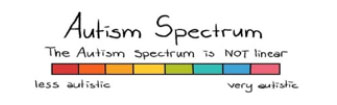
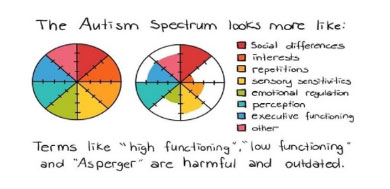
Autism is sometimes described as a spectrum, but this doesn’t mean a line from mild to severe. It means there are many different ways of being autistic. People have different strengths, needs and ways of moving through the world, and these can change depending on the environment, sensory load and how safe a person feels to be themselves.
Often, autism is still understood in a narrow or stereotyped way, which can overlook or misunderstand many autistic experiences. The term “spectrum” simply helps us recognise this variety.
Some people think autism looks like this4
When it actually looks more like this
It’s important to understand that a student’s capacity can fluctuate and change from day to day (or moment to moment).
For some autistic students, this can shift depending on many factors including sensory load, tiredness, stress or changes in routine. This might be clear to others, or it may be less visible, particularly for students who mask.
For others, their support needs and capacity remain more consistent over time.
In all cases, support should be responsive to what the student is experiencing in the moment, rather than relying on how they have ‘managed‘ in the past.
1. Reframing Autism. About Autism. https://reframingautism.org.au/ about-autism/ 2. CDC Autism and Developmental Disabilities Monitoring (ADDM) Network (2023). Prevalence and Characteristics of Autism Spectrum Disorder Among Children Aged 8 Years. MMWR Surveillance Summary, 72(No. SS-2):1–14. DOI: http://dx.doi.org/10.15585/mmwr.ss7202a1 3. Aspect Australia (2024). At least 1 in 40 Australians are autistic. Autism Spectrum Australia. www.aspect.org.au/news/at-least-1-in-40- australians-are-autistic 4. Burgess, Rebecca (2019) “Understanding the Spectrum,” Ought: The Journal of Autistic Culture: Vol. 1: Iss. 1, Article 8. DOI: 10.9707/2833-1508.1020